
Good consent management is not only about complying with legislation. It is about building trust, strengthening the customer journey, and improving business performance. In this article, we look at how to build a modern consent strategy while increasing both conversion and customer satisfaction.
Consent is more than a legal requirement
In many companies, consent is still treated as a legal formality that must be handled to avoid fines. In reality, consent is a strategic key to both trust and conversion. A well-designed consent strategy helps you to:
- Increase customer trust in your brand
- Improve performance across digital channels
- Create a more consistent customer journey
- Document compliance and reduce risk
It is no longer enough simply to “have consent under control”. A modern strategy is about designing an experience that is transparent, user-friendly, and valuable to the customer.
Put the customer first: relevance and trust in the consent journey
For customers, the consent journey is part of the overall brand experience. This is where you have the opportunity to demonstrate respect, transparency, and professionalism while also creating engagement. Four principles are common to successful modern consent strategies:
- Provide context:Explain what the customer gains by giving consent. “Would you like news and offers?” is not enough. Make the value clear.
- Respect the customer’s time and understanding: Keep the language simple and make it easy to say both yes and no. Changing preferences should feel intuitive and safe.
- Think across channels: When consent is stored in silos across CRM, email, customer service, and campaigns, you lose both visibility and trust. A unified flow creates consistency and control.
- Be transparent and clear: Avoid unnecessary legal jargon. Use language that shows you take customer data and the customer experience seriously.
Strategic approaches: what successful companies do
Experience from companies that have succeeded with modern consent management points to three fundamental approaches:
- Centralization: Bring all consents together in one place, regardless of whether they originate from the website, customer service, or campaigns. This reduces the risk of errors and makes it easier to respond quickly.
- Orchestration: Make sure data flows correctly between systems. When a customer gives consent in one place, it should automatically be available where relevant in other systems.
- Personalized control: Give customers control over their own preferences. When customers experience genuine choice, engagement and loyalty increase.
What should a modern consent strategy include?
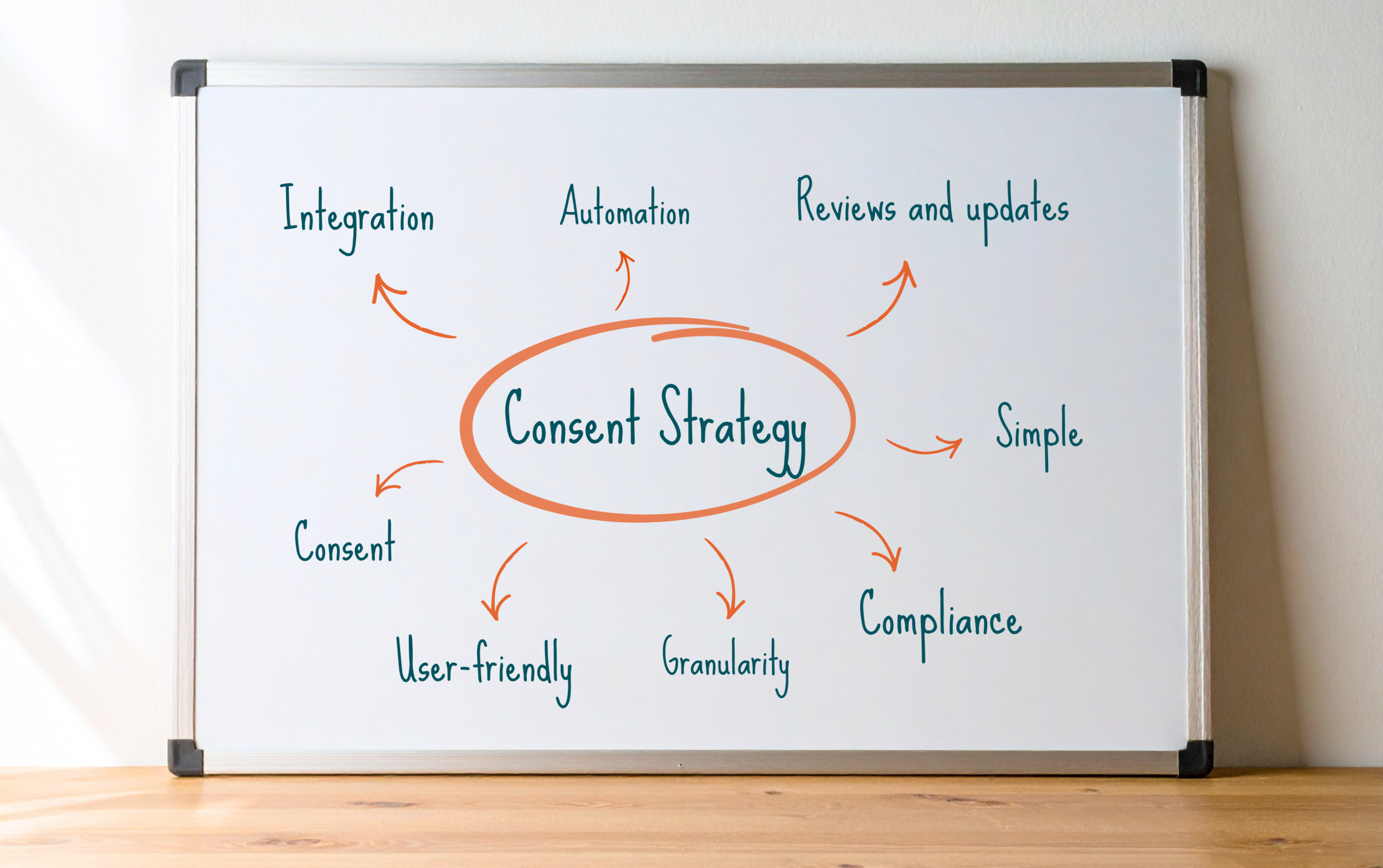
If you want to build a future-proof and customer-friendly setup, there are six key areas to consider:
✅ Granular consent: Allow users to make separate choices for different purposes, such as newsletters, offers, profiling, or third-party data sharing. This improves both transparency and data quality.
✅ Integration with CMS, CRM, and email marketing: An effective consent flow requires strong technical integration so data remains accurate and up to date across systems.
✅ Automated data retention: Define clear rules for when consents and data should be deleted, deactivated, or reconfirmed. This reduces risk and supports compliance.
✅ Regular reviews and updates: Consent practices must evolve with both the business and legislation. Review texts, flows, and integrations at least once a year, preferably more often.
✅ A simple and user-friendly interface: An intuitive preference center where users can easily view and update their choices is essential for trust and transparency.
✅ Compliance with legislation: GDPR and the Danish Marketing Practices Act form the legal foundation. But compliance should not come at the expense of a good user experience – the two are closely connected.
💡 Tip: Use these points as a checklist for an internal review. Where are you strong, and where are there gaps in your current setup?
Inspiration from real-world practice
More and more companies are treating consent as an important part of the customer experience. Some are building user-friendly preference centers, while others integrate consent directly into lead flows and marketing automation. The common denominator is simple: they make it easy to be a customer and easy to remain compliant.
Conclusion: start simple and think holistically
You do not need to start from scratch or invest in an entirely new system to improve your consent strategy. But you do need to make deliberate choices and think across the business. Ask yourselves:
- What role does consent play in our customer journey?
- Do we have a clear overview of data and preferences across systems?
- Are we meeting both legal requirements and customer expectations?
Start with the low-hanging fruit and gradually build a setup that strengthens the customer relationship – and, in turn, the business.
Want to see what it looks like in practice?
RubiqCloud helps companies centralize consent, integrate across systems, and automate the entire process – from consent collection to data retention. 👉 Book a demo and see it in action.